Adding Video, Audio, and Embedded HTML Resources in DITA TopicsHistory | Edit
You can insert references to media resources (such as videos, audio clips, or embedded HTML
frames) in your DITA topics. The media resources can be played directly in
Author mode and in all HTML5-based outputs. There is a toolbar button
( ) that allows you to insert and configure a
reference to the media resource.
) that allows you to insert and configure a
reference to the media resource.
Adding a Media Resource
To insert a media resource in a DITA document, use the following procedure:
- Place the cursor at the location where you want the media resource.
- Select the Insert Media
Resource action from the toolbar. The Insert Media
dialog box appears.
Figure: Insert Media Dialog Box
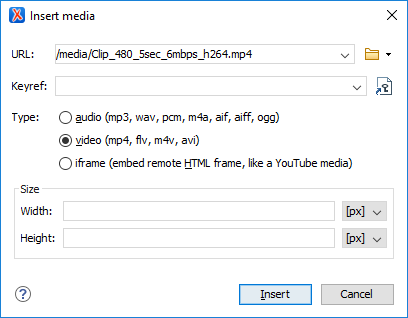
- Configure the options in this dialog box and click Insert.The Insert Media dialog box includes the following options:
- URL
- Use this option to specify a URL for a media resource. It will insert the URL as
the value of a
dataattribute of anobjectelement. You can type the URL of the resource you want to insert or use the Browse drop-down menu to select it.
 - Keyref
- You can use the
 Choose Key
Reference button to open the Choose Key
dialog box that presents the list of keys available in the selected root map. Use
this dialog box to insert the selected key as the value of the
Choose Key
Reference button to open the Choose Key
dialog box that presents the list of keys available in the selected root map. Use
this dialog box to insert the selected key as the value of the
datakeyrefattribute of anobjectelement. All keys that are presented in the dialog box are gathered from the root map of the current DITA map.Tip: If your defined keys are not listed in this dialog box, it is most likely trying to gather keys from the wrong root map. You can change the root map by using the Change Root Map link. - Type
- Oxygen XML Editor detects and automatically selects the media type based
upon the specified resource in the URL field. You can manually change the type, but keep in
mind that in the publishing stage the
objectelement is converted to an HTML5 element based upon the type selected here. You can choose between: audio, video, or iframe. - Size
- Use this section to configure the Width and
Height of the frame for the media resource. Specifying a
value in these options inserts a
widthandheightattribute, respectively. For audio clips, only the Width can be adjusted.
Result in Author Mode: A reference to the specified video, audio, or embedded HTML
frame is inserted in an object element and it is rendered in
Author mode so that it can be played directly from there.
Result in Output: In the publishing stage, the
object element is converted to an HTML5 element so that it can be
rendered properly and played in all HTML5-based outputs.- Videos - The
objectelement is converted to an HTML5videoelement. - Audio Clips - The
objectelement is converted to an HTML5audioelement. - Embedded HTML Frames - The
objectelement is converted to an HTML5iframeelement.
Tip: There is an even faster way of inserting an embedded video (such as a YouTube
or Vimeo). If you copy the embed code from the source (for example, you can right-click on a
YouTube video and select Copy embed code), you can then paste the
contents of the clipboard in the URL field, and the Type will automatically be set on
iframe, while the Width and Height will
be populated according to the detected size.